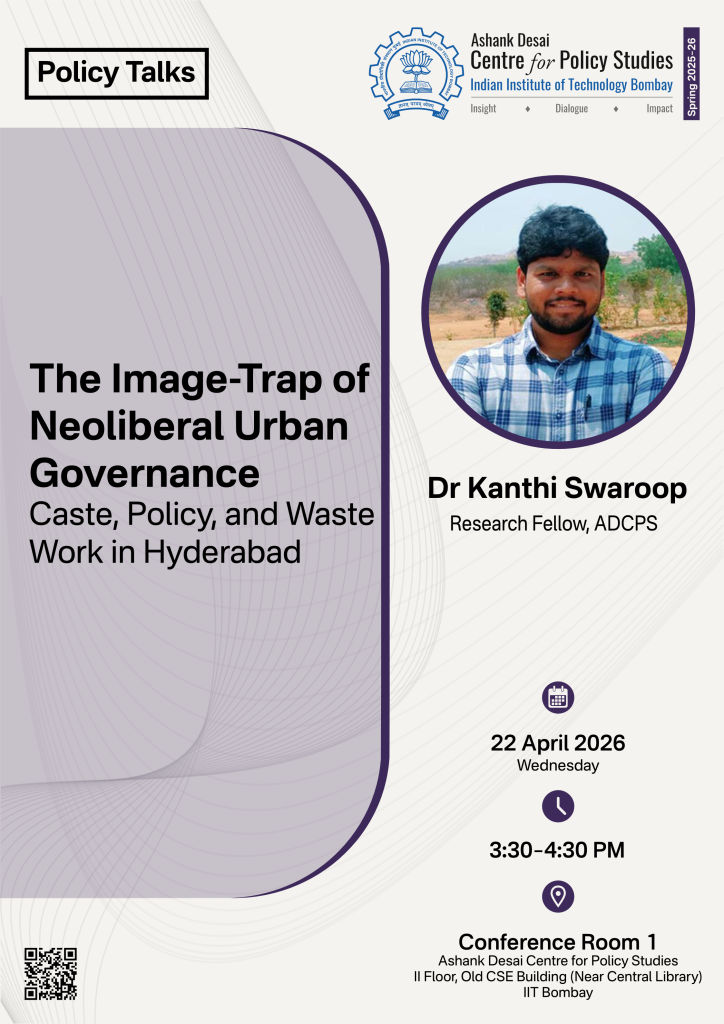
Abstract: What happens when publicity becomes not the medium of policy, but its substance? In Indian cities, urban governance and development have become strategic arenas for spectacular political performances, giving rise to a new mode of policymaking through which ruling regimes stage their political identity. While scholarship on policy instruments focuses on how the neoliberal turn has restructured technologies of rule through outsourcing, privatization, and fragmentation of institutions, there is insufficient attention to the transformation of policymaking practices and their implications for everyday governance. This paper will examine the relationship between urban transformations and policy instruments in Hyderabad, where I have conducted the fieldwork since 2018. In post-Telangana Hyderabad, the promise of state reconstruction has generated a proliferation of policy instruments, fixing issues ranging from service delivery to strengthening the regional political economy. Policy-ethnography of such transformations to waste work and sanitation infrastructures reveals that these instruments also exist simultaneously as objects of performance, enacting the regime’s identity, and in some cases as mass-mediatized events shaping public consciousness. Arguing policy as spectacle, the paper explores: how and under what conditions these political performances become spectacles that legitimize policy instruments? And what might a critical policy account of such phenomena teach us about contemporary policymaking and its consequences for urban governance in Indian cities.
Speaker Bio-sketch: Dr Kanthi Swaroop is Research Fellow at the Ashank Desai Centre for Policy Studies, IIT Bombay, where he also earned his PhD. His research explores how policy transformation is experienced in everyday governance of Indian cities, bridging theory, practice, and public policy. His articles engage with twin issues of caste and neoliberal governance, focusing on topics including the urban sanitation, social stratification, sanitation labour in pandemic times. His dissertation won a prestigious fieldwork grant from – the Initiative of Sanitation Workers, a global partnership between SNV, ILO, World Bank and WaterAid.