
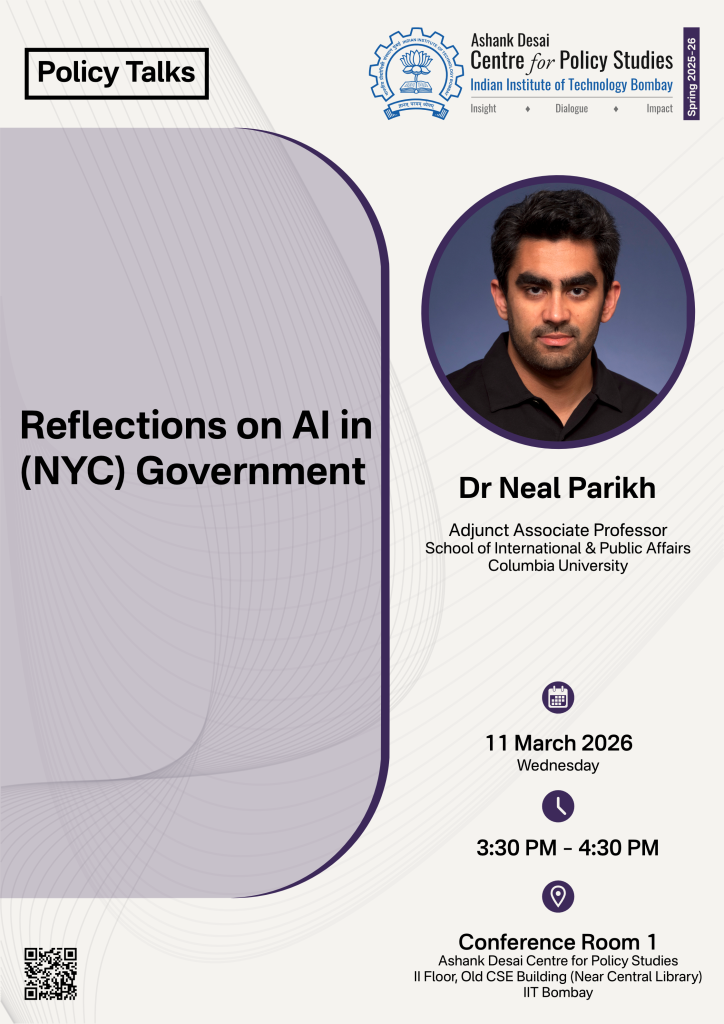
Abstract: AI and machine learning have emerged as increasingly ubiquitous technologies in a wide range of areas in both the private sector and in government. In the past several years, ethical and other policy and governance questions around how and whether to use AI for various tasks have become much more prominent, partly due to its widespread use and partly due to publicly documented failures or shortcomings of a number of systems that can negatively impact people in sometimes serious ways. The speaker recently served as the first Director of Artificial Intelligence for New York City, a then-newly created position in the NYC Mayor’s Office with broad responsibilities relating to policy and legislation, technical advisory work, and collaborations or partnerships with universities and other governments. This included publishing the first comprehensive AI Strategy for NYC. This talk will be an informal survey of reflections on this experience from the perspective of a computer scientist new to government. It will emphasize aspects of government in general and this experience in particular that those who have not directly served in a government or policymaking position but are interested in ethical AI or AI policy broadly might find surprising, interesting, or helpful.
Speaker Bio-sketch: Neal Parikh is a computer scientist who most recently served as the first Director of Artificial Intelligence for New York City and is currently Adjunct Associate Professor at Columbia University’s School of International and Public Affairs, where he teaches a course on AI for policymakers. He co-founded SevenFifty, a technology platform acquired after 10 years in operation; was Inaugural Fellow at the Aspen Tech Policy Hub at the Aspen Institute; and worked as a senior quantitative analyst at Goldman Sachs. He received his Ph.D. from Stanford University in machine learning and convex optimization. His research includes two monographs on large-scale convex optimization that are now standard references in the field, with over 30,000 citations in the academic literature and widespread use in industry. This work also forms the mathematical foundation of SCS, an open-source optimization solver downloaded millions of times per month.