
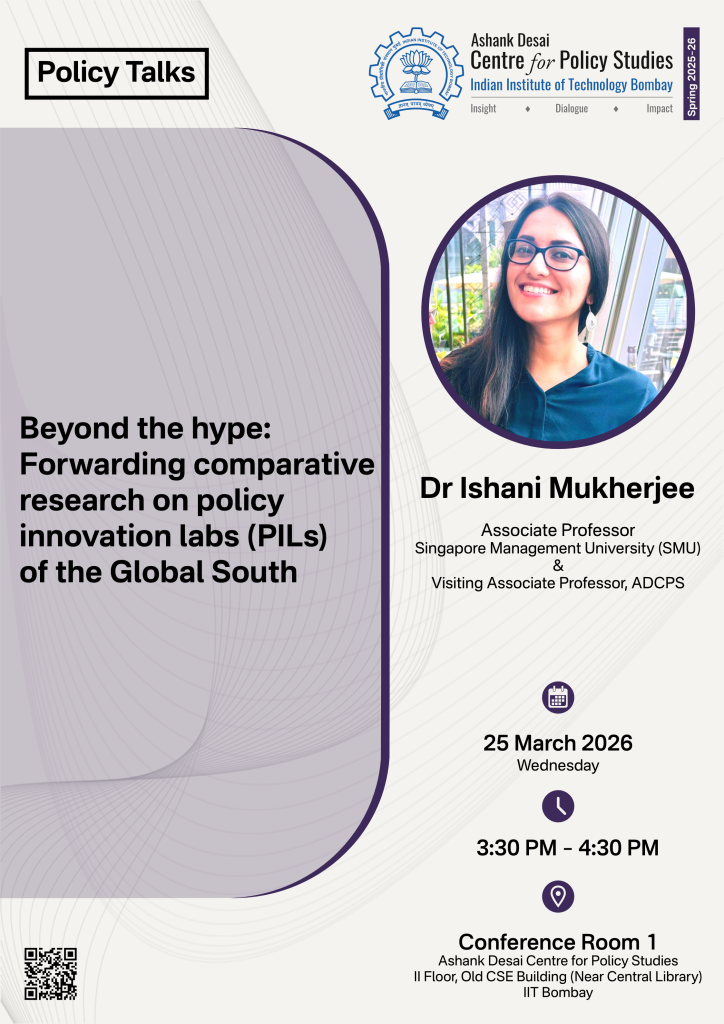
Abstract: Policy Innovation Labs (PILs) are relatively new policy actors as part of a significant global ‘labification’ movement. A critical lament within the policy literature, however, is that the disjointed global ‘hype’ about policy labs has not yet been able to reach any form of definitional consensus, or a concerted way to study the of the impacts and possibilities of policy labs within the policy process.
In parallel, however, the diversity of policy labs in practice is booming given the growing government appetite for policy innovation, making a strong case for developing organizational rubrics that can help forward more comparative research on these entities. Especially in the context of the Global South, policy labs manifest themselves in several forms including (but not limited to) living labs, policy innovation research units through public universities, evidence labs forwarded by research organizations, and sector-specific government owned innovation ‘clusters’.
But, do we have the comparative tools to study what impact they have on the policy process and desired policy outcomes? Can the diversity of PILs be organized to build the policy lab as an important unit of analysis for policy innovation research? This talk covers my most recent work on PILs and presents an organizational framework of analysis for categorizing the wide variety of policy labs that are emerging in practice.
Speaker Bio-sketch: Dr Ishani Mukherjee is Associate Professor of Public Policy, School of Social Sciences, Singapore Management University (SMU). Her expertise include policy formulation and design; environmental and natural resource policy and management; policy tools for renewable energy and energy efficiency, particularly in Asia. Her research has been published in leading disciplinary journals of public policy such as Policy & Society, Policy Sciences and Administration & Society, as well as top-ranked journals of environmental policy such as Renewable Energy, Energy Policy and Renewable & Sustainable Energy Reviews (RSER). She has also jointly authored and edited books on policy formulation and design, most recently published by the Cambridge University Press.